The Second Summit Toolkit - Meaning.
Fourteen existential instruments for the question after success.
For those who suspect, somewhere near the summit, that the mountain they climbed was never the mountain they meant to climb, leaders and founders for whom success has stopped answering the deeper questions and who would rather face that honestly than out-climb it.
Fourteen tools, selected from the full Second Summit method and re-sequenced into four stages - the working instruments for turning the "is this all?" moment into a direction.


What's inside - four stages, fourteen tools
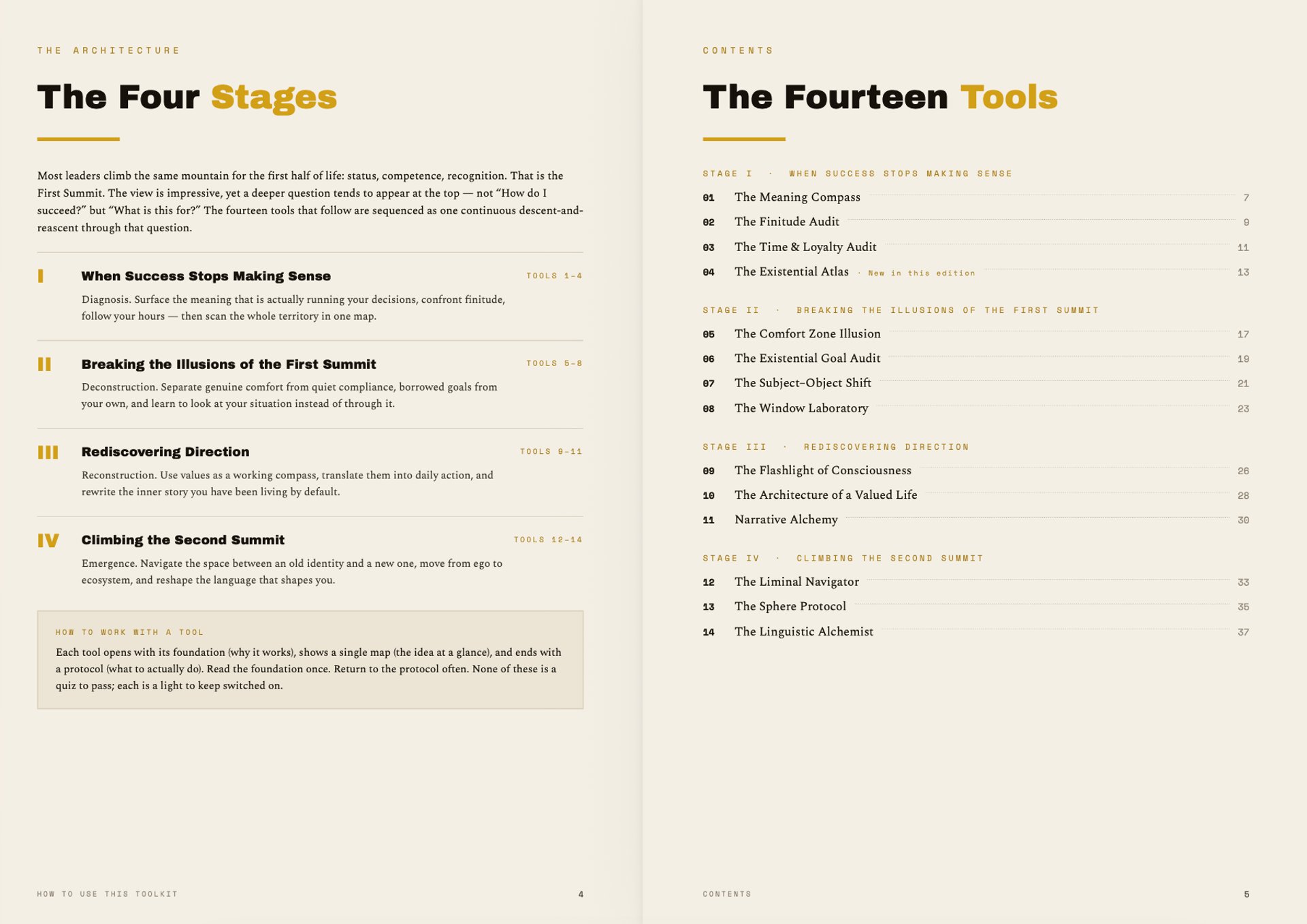
I · When Success Stops Making Sense: surface the meaning actually running your decisions, confront finitude, see where your hours and loyalties truly go, and map your whole life-space.
II · Breaking the Illusions of the First Summit: separate genuine comfort from quiet compliance, borrowed goals from your own, and learn to look at your situation instead of through it.
III · Rediscovering Direction: use values as a working compass, translate them into daily action, and rewrite the inner story you've been living by default.
IV · Climbing the Second Summit: navigate the space between an old identity and a new one, move from ego to ecosystem, and reshape the language that shapes you.
Frequently asked questions
Is this therapy or self-help?
Neither. It's a field manual built on existential philosophy and coaching science - practical, structured, and honest.
Do I need to read philosophy first?
No. Each tool brings the idea you need and tells you what to do with it.
How does each tool work?
Each opens with its foundation (why it works), shows one map (the idea at a glance), and ends with a protocol (what to actually do). Read the foundation once. Return to the protocol often. None of these is a quiz to pass; each is a light to keep switched on.
Start here if you'd rather think before you talk. Most people who end up working with me did the tools first.
If you want to talk, write to me. george@bragadireanu.com
Tell me as much or as little as you want. I read and answer everything myself, usually within a day. If a conversation makes sense after that, we'll have a short one to detail your dilemmas before jumping into coaching, at no cost and with nothing expected after it.